Aisha: A First Look at the AI WhatsApp Assistant Built for Kenya's Social Sellers
By Day Zero Guides Editorial · How we produce guides
Some links in this guide are affiliate links. If you sign up through them, Day Zero Guides may earn a commission at no extra cost to you. This never affects which products we cover or what we say about them. See our affiliate disclosure for details.
Concrete use cases
- A reseller selling secondhand clothing (mitumba) via Instagram and WhatsApp stories gets tired of manually replying "Is this still available?" 50 times a day — Aisha handles the repetitive replies and only escalates real negotiations to the seller.
- A home baker taking cake orders through WhatsApp uses the payment tracker to confirm M-Pesa deposits before starting an order, instead of manually cross-checking M-Pesa SMS alerts against a notebook.
- A skincare importer who takes pre-orders and ships in batches uses ghosting detection to catch customers who asked for a price, went silent, and never confirmed — recovering sales that would otherwise be lost to inbox fatigue.
- A small business owner running promotions through Paystack for card payments alongside M-Pesa for local buyers uses Aisha's dashboard to see which payment method actually converts better week to week.
What Aisha actually does
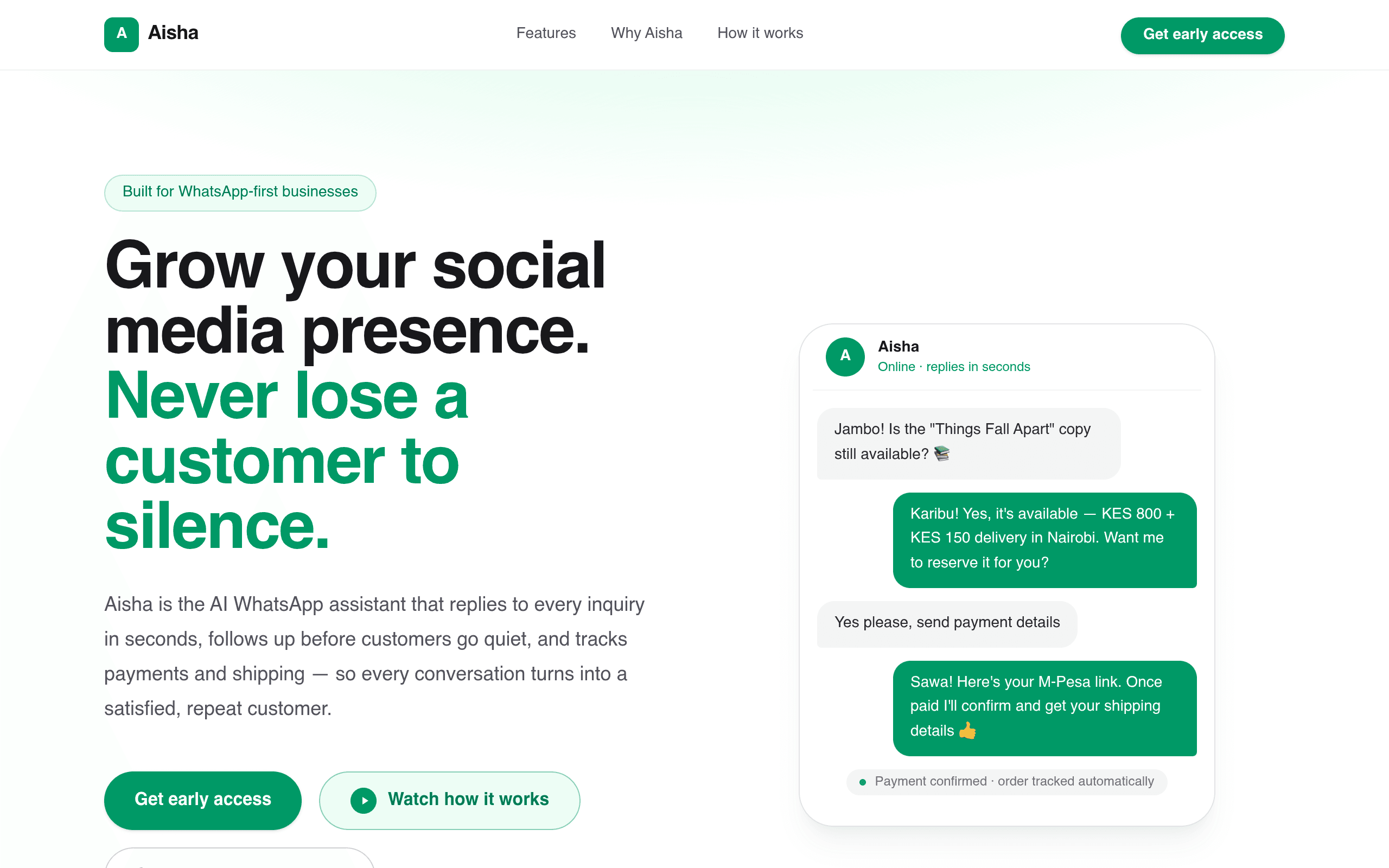
Aisha (thetechhut.co) is a narrow, purpose-built AI assistant that lives inside WhatsApp Business — not a generic chatbot builder you have to configure for weeks. It's aimed squarely at social sellers and micro-businesses in Kenya who run their entire operation through WhatsApp DMs: think Instagram thrift resellers, home bakers, skincare importers, and mama mbogas who've moved to digital orders.
Four things it does out of the box:
- Automated customer replies — answers common questions (price, availability, delivery time) without the seller typing the same answer 40 times a day.
- Ghosting detection — flags when a customer goes quiet mid-conversation after showing buying intent, then sends a timed follow-up nudge automatically.
- Payment and shipping tracking — logs who's paid, who hasn't, and where an order is in the delivery process, tied to M-Pesa, Paystack, or Stripe transactions.
- Creator dashboard analytics — a simple view of conversation volume, conversion rate, and revenue per week, so a seller running their business solo can see what's working without exporting spreadsheets.
It integrates directly with the WhatsApp Business API rather than asking you to migrate customers to a new inbox, which matters a lot in a market where WhatsApp is the storefront.
Pricing (as of launch)
Aisha runs two tiers, priced in Kenyan shillings — a deliberate choice that keeps it accessible for micro-sellers rather than pricing in USD like most competitors:
| Plan | Price | What you get |
|---|---|---|
| Starter | KES 500/month (~$3.90) | Core automation: replies, ghosting follow-ups, payment tracking, basic dashboard, limited product catalog |
| Pro | KES 1,500/month (~$11.60) | Everything in Starter, plus unlimited products and priority support |
There's no free-forever tier, but at KES 500/month the entry price is low enough that it's roughly the cost of a bundle of mobile data — a deliberate fit for the customer base it's targeting, versus tools priced for US or EU small businesses.
How it compares
Aisha isn't trying to be a general-purpose chat platform — it's WhatsApp-only and Kenya-first. That's the main thing to understand when comparing it to bigger, more established players.
| Aisha | Tidio | ManyChat | Intercom | |
|---|---|---|---|---|
| Starting price | KES 500/mo (~$4) | Free tier; paid plans from ~$29/mo | Free tier; paid plans from ~$15/mo | From ~$39/mo per seat |
| WhatsApp integration | Native, core to the product | Available as a paid add-on | Available via WhatsApp API add-on | Available, but positioned for enterprise support teams |
| Local payment rails | Native M-Pesa, Paystack, and Stripe support | None built in | None built in | None built in |
| Ghosting/follow-up detection | Built-in, automatic | Not a native feature | Possible via manual flow builder, not automatic | Requires custom workflow setup |
| Best for | Individual sellers running a business entirely through WhatsApp | Website live chat and basic ecommerce support | Broad messenger marketing across FB, IG, and WhatsApp | Mid-market to enterprise customer support teams |
If you're a US or European ecommerce store running live chat on a website, Tidio or Intercom still make more sense. If you're running broad multi-channel drip campaigns across Instagram and Facebook, ManyChat's flow builder is more mature. But none of the three were built with M-Pesa reconciliation or Kenyan Shilling pricing in mind — that gap is exactly what Aisha is filling.
Should you try it today
Try it if: you're running sales entirely through WhatsApp DMs, you're currently tracking payments and orders manually (notebook, spreadsheet, or memory), and KES 500–1,500/month is a trivial cost relative to what you're losing to missed follow-ups.
Hold off if: you need omnichannel support across email, live chat, and social in one inbox — Aisha doesn't do that, and isn't trying to. Also worth noting this is a newly launched product, so ask about WhatsApp Business API approval times and data handling before fully switching your customer communication over, especially if you're already mid-season with active orders.
For the specific problem it solves — a solo seller losing money to ghosted chats and messy payment tracking on WhatsApp — Aisha is priced and built for that exact person, not adapted from a broader platform after the fact. That focus is its real differentiator against Tidio, ManyChat, and Intercom, none of which were designed around M-Pesa or the realities of running a business entirely inside WhatsApp.