Aurzen Projector Review: ZIP, EAZZE, and BOOM Series Compared
By Day Zero Guides Editorial · How we produce guides
Some links in this guide are affiliate links. If you sign up through them, Day Zero Guides may earn a commission at no extra cost to you. This never affects which products we cover or what we say about them. See our affiliate disclosure for details.
The scenario where Aurzen makes sense
You're packing for a weekend camping trip and want to project a movie onto the side of a tent or a hung sheet after dinner, without hauling a full home theater setup or paying $600+ for a name-brand mini projector. You need something that fits in a backpack side pocket, runs on battery for at least a couple hours, and doesn't require a dedicated screen or perfect darkness to look watchable. This is the exact niche Aurzen's ZIP series is built for — and it's the clearest reason to consider the brand over bigger names like Anker or Epson, who tend to price that same portability at a premium.
If your use case is different — say, a semi-permanent backyard movie setup or a home office presentation screen — Aurzen's BOOM and EAZZE lines target those scenarios too, but the value proposition shifts, and that's worth understanding before you buy.
What Aurzen actually is
Aurzen is a projector-focused hardware brand selling direct-to-consumer through aurzen.com, with three main product lines:
- ZIP series — compact, pocketable projectors aimed at travel, camping, and casual outdoor viewing. This is the entry point and the most frequently discounted line.
- EAZZE series — a step up in brightness and features, positioned as an easier all-around indoor/outdoor projector for people who want one device for movie nights and casual presentations.
- BOOM series — the largest and loudest of the three, with built-in speakers pitched for backyard movie nights and small gatherings where audio matters as much as picture.
Aurzen also sells accessories (tripods, screens, carrying cases) alongside the projectors, and ships to multiple international markets, which suggests a reasonably established supply chain rather than a single-market startup.
Pricing: what's actually published
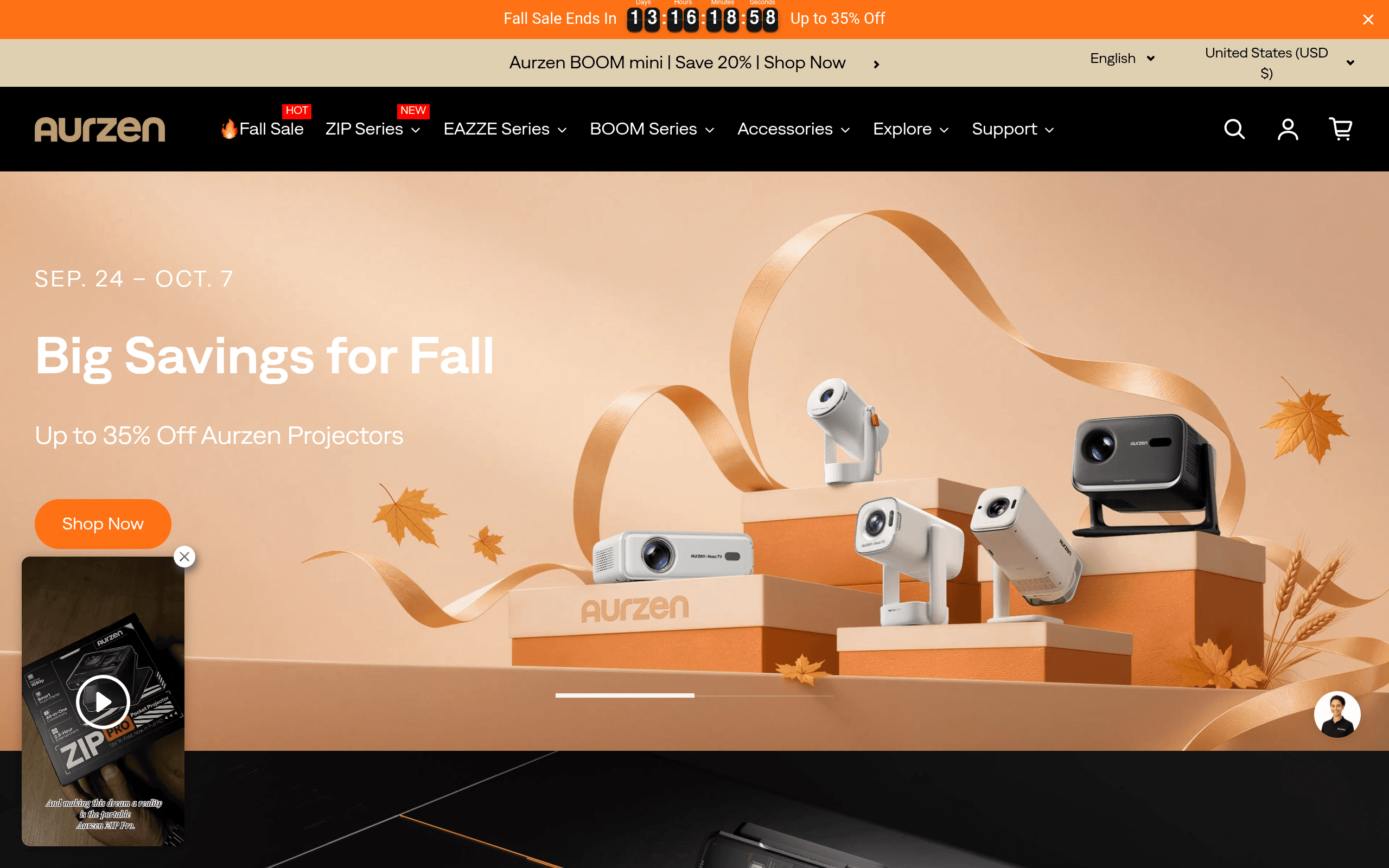
This is the part where Aurzen is less transparent than competitors. The site frequently advertises percentage-based discounts — a fall sale up to 35% off, 8% off the ZIP Pro, 20% off the BOOM mini — but consistent, stable list prices are harder to pin down site-wide, and they shift with whatever promotion is currently running. Based on current and recent listings, expect rough street pricing in these bands:
- ZIP series: roughly $150–$280 depending on model and active discount
- EAZZE series: roughly $250–$400
- BOOM series: roughly $300–$500+
Treat these as ballparks, not quotes — verify the current price on the product page before buying, since the "sale" price is effectively the real price most of the time. If you're comparing against competitors' MSRPs, that's a meaningful advantage for budget-conscious buyers, but it also makes Aurzen harder to comparison-shop confidently, since there's no stable anchor price to reference.
How it compares
| Aurzen (ZIP/EAZZE/BOOM) | Anker Nebula (Capsule 3 / Mars 3) | ASUS VivoBeam (Q2) | Epson EpiqVision (Flex/Mini) | |
|---|---|---|---|---|
| Typical price | ~$150–$500 (varies with frequent sales) | ~$299 (Capsule 3) to ~$599 (Mars 3) | ~$249–$399 | ~$549–$799 |
| Key strength | Low entry price, portability across three tiers | Android TV built-in, strong app/streaming ecosystem | Compact design, solid brightness-to-size ratio | Epson's projection optics and color accuracy |
| Battery/portability | ZIP line built specifically around pocket portability | Capsule 3 is similarly pocket-sized; Mars 3 is bulkier, tripod-style | Portable but slightly less pocket-friendly than ZIP or Capsule | Least portable of the group; built more for fixed indoor use |
| Best for | Budget travel/camping use, casual backyard viewing | Buyers who want a smart-TV experience out of the box | Buyers prioritizing brightness in a small footprint | Buyers who care most about picture quality and don't mind less portability |
| Support/ecosystem | Smaller brand, direct-to-consumer support only | Established support network, wide retail availability (Best Buy, Amazon) | Backed by ASUS's broader retail and warranty infrastructure | Backed by Epson's long-standing projector service network |
Concrete use cases where Aurzen fits
- Camping and van life: ZIP models are small enough to justify packing even when space is tight, and don't represent a huge loss if damaged on a trip, unlike a $600 Nebula Mars.
- Dorm rooms: EAZZE-tier projectors work as a secondary screen for movies or shared viewing without the footprint of a TV.
- Backyard movie nights: BOOM's built-in speaker focus is aimed squarely at this — skip a separate Bluetooth speaker setup if you don't want the added cost or clutter.
- Casual business travel: any of the three lines can drive a basic slide deck presentation in a pinch, though none of them are pitched as boardroom-grade like some Epson models.
Where Aurzen falls short
- No smart platform built in the way Anker's Nebula line offers with Android TV — you'll likely be casting from a phone or laptop, or plugging in a streaming stick.
- Brightness and color accuracy are unlikely to match Epson's optics at a given price point — Epson's projector heritage still shows in output quality even on its budget EpiqVision Flex line.
- Retail availability is limited — you're mostly buying direct from aurzen.com rather than picking one up at Best Buy or through a retailer with an established return desk, which matters if you want an easy return or warranty claim.
- Pricing volatility makes it hard to know if you're getting the deal the site implies, or just the standard price disguised as a discount.
Bottom line
Aurzen is a reasonable pick if your priority is getting a genuinely portable, low-cost projector for casual, occasional use — camping trips, backyard nights, dorm rooms — and you're comfortable buying direct from a smaller brand without big-box retail backup. If you want a polished smart-TV experience, choose Anker's Nebula line. If picture quality is non-negotiable, Epson's EpiqVision series is worth the premium. If you want a small brand-name safety net at a similar price to Aurzen, ASUS VivoBeam is the middle ground. Aurzen earns its place specifically at the budget end of the portable projector market — just go in knowing the pricing structure is fluid and the support ecosystem is thinner than the bigger names it's compared against here.