Creality Review: Pricing, Product Lines, and How It Compares to Prusa, Anycubic, and xTool
By Day Zero Guides Editorial · How we produce guides
Some links in this guide are affiliate links. If you sign up through them, Day Zero Guides may earn a commission at no extra cost to you. This never affects which products we cover or what we say about them. See our affiliate disclosure for details.
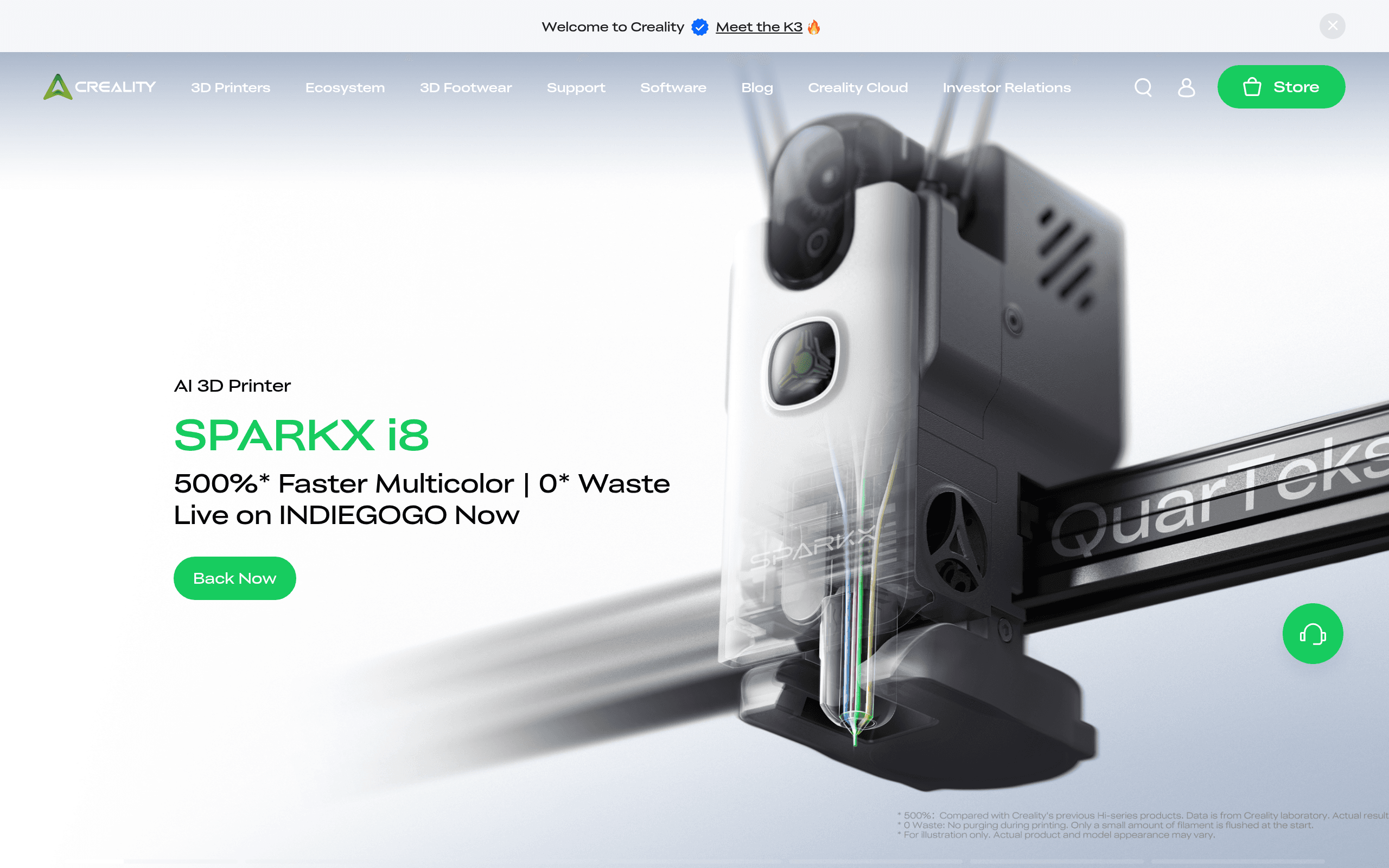
The scenario: you want to print functional parts at home without spending $1,000+
Say you're a hobbyist who needs to print a replacement bracket for a broken appliance, a custom enclosure for a Raspberry Pi project, or a batch of cosplay props before a convention. You don't need aerospace-grade tolerances — you need a printer that works most of the time, ships with a big enough bed to handle real parts, and doesn't require you to remortgage your house. This is the exact use case where a Creality K1 or Ender 3 V3 SE gets recommended in every 3D printing subreddit and Discord server, and it's the right starting point for understanding what the company actually does well.
If that scenario doesn't sound like you — say you're doing dimensionally critical engineering prototypes, or you want the single most polished out-of-box software experience regardless of cost — the calculus changes, and this guide gets into where Creality stops being the obvious answer.
What Creality actually is
Creality is a Shenzhen-based hardware manufacturer that's been building consumer and prosumer 3D printers since 2014, and has since expanded into resin (LCD/MSLA) printers under the Halot brand, laser engravers under the Falcon line, and 3D scanners under the CR-Scan line. It's not a single product — it's a catalog spanning roughly $150 entry-level FDM printers up to $1,000+ enclosed multi-color machines, plus a companion app/slicer ecosystem (Creality Print) and a model-sharing platform (Creality Cloud) that ties the hardware together.
The company's core reputation was built on the Ender 3 line, which became the de facto "first 3D printer" for a huge share of the hobbyist market between 2018 and 2022 because it was cheap, had a massive community, and was easy to mod. That reputation is both an asset (huge parts/support ecosystem, tons of YouTube troubleshooting content) and a liability (older Ender models had real quality-control inconsistency, and some early firmware/support experiences were rough).
Pricing by product line
Creality doesn't post a single price list on its homepage — pricing lives on individual product pages and fluctuates with frequent sales — but here's roughly where things sit as of current listings:
- Ender 3 V3 SE — around $199, basic FDM, no auto bed leveling on the cheapest variant
- Ender 3 V3 KE — around $259–$299, faster (500mm/s claimed), input shaping, CoreXZ motion
- K1 / K1C — around $399–$599, enclosed, high-speed CoreXY, closer to a Bambu Lab-style experience
- K1 Max — around $799–$949, same speed class with a larger 300x300x300mm volume
- Halot One Plus (resin) — around $259–$299, entry MSLA resin printer
- Halot Mage / Mage Pro (resin) — around $399–$599, larger build volume, better light source uniformity
- Falcon2 laser engravers — around $339 (12W) to $700+ (40W or dual-laser kits)
- CR-Scan Otter (3D scanner) — around $339–$379
- CR-Scan Raptor — around $1,099, higher-accuracy handheld scanner aimed at professionals
The practical takeaway: budget for the machine itself, then add $30–$80 for a hardened steel nozzle, a better build plate, or an enclosure kit if you're printing engineering-grade filaments like ABS or nylon — these upgrades aren't usually included at the lower price tiers.
Concrete use cases where Creality makes sense
- Prototyping at home or in a small shop: The K1/K1C's speed (real-world 300-400mm/s for simple geometry) means you can iterate on a design multiple times a day instead of once.
- Classroom or makerspace fleets: The Ender 3 V3 SE's low per-unit cost makes it realistic to outfit 10-20 units for a school program on a limited budget.
- Miniatures and jewelry patterns: The Halot resin line handles the fine detail these require far better than any FDM printer, at a fraction of the cost of a Formlabs setup.
- Small-business laser engraving side jobs: A Falcon2 22W or 40W can cut light plywood/acrylic and engrave tumblers/wood signs — enough capability for an Etsy-scale operation without buying a $2,000+ CO2 laser.
- Reverse-engineering a part with no CAD file: The CR-Scan Otter is genuinely useful for capturing an odd-shaped bracket or cosplay armor piece to bring into CAD software for cleanup and reprinting.
Where Creality falls short
- Quality control varies by unit, more so than Prusa. It's common enough to see forum threads about a printer arriving with a slightly warped bed or a loose belt that it's worth budgeting an hour of first-run troubleshooting.
- Software polish lags Bambu Lab and Prusa. Creality Print (their slicer) has improved a lot but still isn't as smooth as PrusaSlicer's presets or Bambu Studio's cloud integration.
- Support response time is generally slower than Prusa's, based on widely reported user experience — expect email-ticket turnaround in days, not hours.
How it compares
| Creality (K1/Ender line) | Prusa Research (MK4/MINI+) | Anycubic (Photon Mono line) | xTool (D1 Pro/S1) | |
|---|---|---|---|---|
| Starting price | ~$199 (Ender 3 V3 SE) | ~$429 (MINI+), ~$799 kit / $1,099 assembled (MK4) | ~$259–$399 (resin printers) | ~$439 (D1 Pro laser), ~$999 (S1 enclosed) |
| Technology | FDM (Ender, K1) + resin (Halot) + laser (Falcon) | FDM only | Resin (MSLA) only | Laser engraving/cutting only |
| Build quality/consistency | Good but variable unit-to-unit | Best-in-class, tight QC, known for reliability | Good for the price, resin printers are simpler mechanically | Solid, aimed at hobbyist-to-small-business users |
| Software ecosystem | Creality Print + Creality Cloud, functional but less polished | PrusaSlicer, widely considered the gold standard | Anycubic Photon Workshop, adequate but basic | xTool Creative Space, purpose-built and fairly intuitive |
| Best for | Budget-to-midrange FDM buyers who want speed and variety of machine types | Buyers who want the most reliable, well-supported single printer and don't mind paying more | Buyers focused specifically on high-detail resin printing (minis, jewelry) | Buyers who specifically want laser cutting/engraving, not FDM printing |
| Community/parts support | Very large, long-established (Ender ecosystem) | Large, especially for repairs/upgrades | Large within the resin-printing niche | Growing but smaller than Creality/Prusa |
The verdict
Creality is the right call if you want to get into 3D printing, resin printing, or laser engraving without spending Prusa or Bambu Lab money, and you're willing to tolerate some hands-on troubleshooting in exchange for lower cost and a wider range of machine types under one brand. The K1/K1C in particular is a legitimately strong value at its price point if you're comparing it to enclosed CoreXY machines twice the cost.
It's not the right call if reliability out-of-the-box matters more to you than price — that's still Prusa's territory — or if you're narrowly focused on one discipline (resin detail work leans Anycubic, laser work leans xTool) where a specialist brand's software and community will serve you better than Creality's broader-but-thinner ecosystem in that specific category.