Unidata U30 Review: How the CloudSIM Hotspot Works, What It Costs, and Who It's For
By Day Zero Guides Editorial · How we produce guides
Some links in this guide are affiliate links. If you sign up through them, Day Zero Guides may earn a commission at no extra cost to you. This never affects which products we cover or what we say about them. See our affiliate disclosure for details.
The Scenario Where This Device Actually Earns Its Keep
You land in Lisbon on a Tuesday, fly to Bangkok the following week for a work trip, and finish the month in Mexico City visiting family. In the old model, that's three airport SIM kiosks, three phone numbers you'll never use again, and at least one moment of standing in an arrivals hall trying to remember your passport PIN so you can activate a prepaid card in a language you don't speak. This is the exact situation the Unidata U30 is built for. You buy the device once, and instead of swapping physical SIM cards at every border, you open Unidata's app and buy a local data package for whatever country you've just landed in — no kiosk, no new SIM tray tool, no roaming surcharges from your home carrier. If you're the kind of traveler who crosses three or more countries in a single trip, or you manage travel logistics for a small team that does, this is the practical reason to own one of these over just paying your phone carrier for international roaming.
If your travel is one country, one time a year, this device is overkill — a local prepaid SIM or your carrier's day-pass roaming plan will be cheaper and simpler. The U30 earns its cost on frequency and geographic spread of travel, not on any single trip.
What the U30 Actually Is
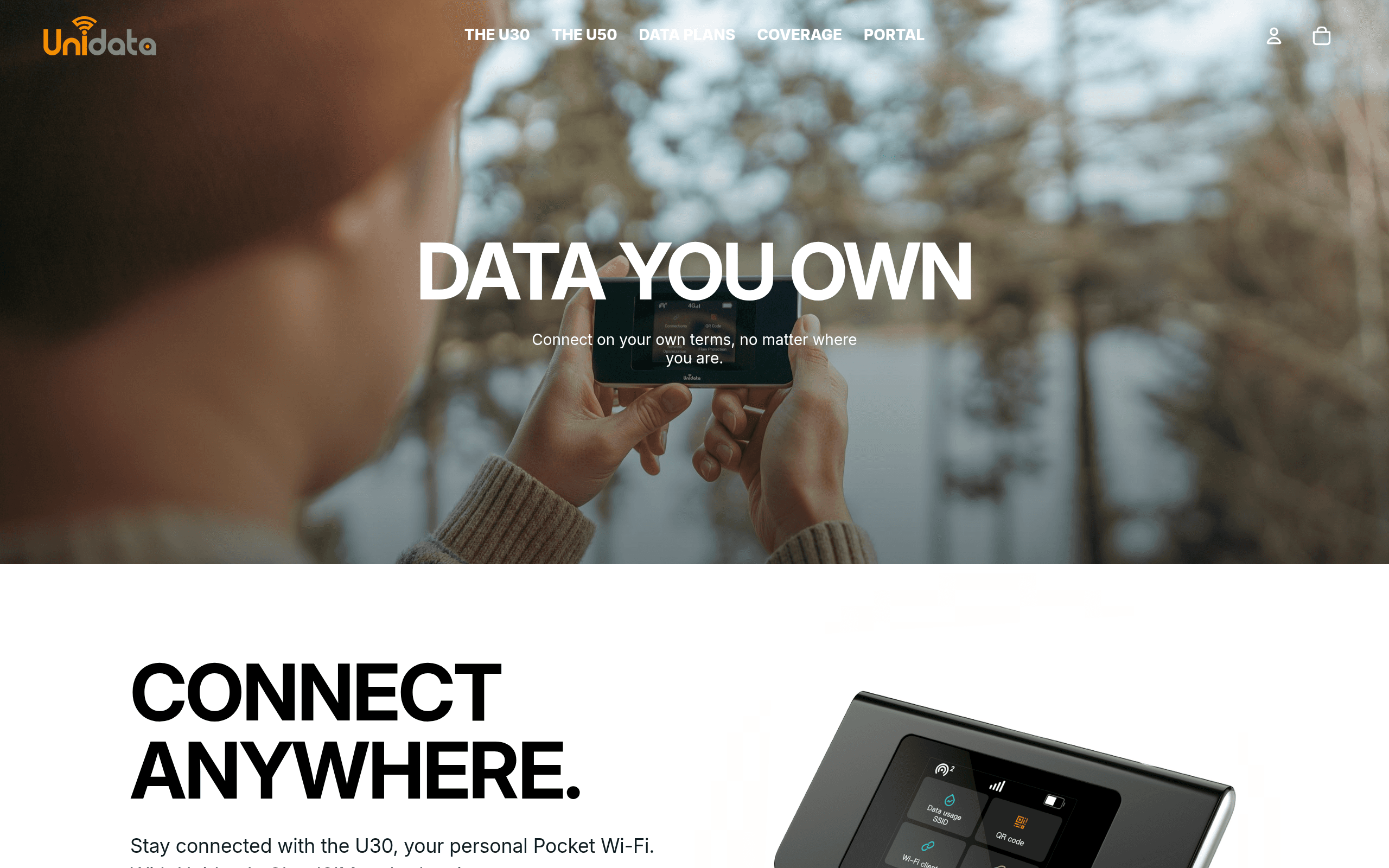
The Unidata U30 is a pocket-sized 4G LTE mobile hotspot built around "CloudSIM" technology — an embedded, software-based SIM that lets the device pull from a library of local network partnerships in a given country rather than requiring you to insert a physical SIM. Practically, this means:
- You buy the hardware once.
- You buy data separately, per trip or per region, through the companion app.
- The device connects to a local carrier's network in whatever country you're in, so you get local-network speeds and reliability rather than routing through an expensive international roaming agreement.
- Up to 10 devices (phones, laptops, tablets) can join the same hotspot, which matters if you're traveling with family or colleagues and want to split one data pool instead of paying for individual roaming plans.
- Battery is rated at 12 hours of continuous use, which covers a full day of sightseeing or a long-haul flight plus arrival, but you'll still want a charging cable or battery pack for multi-day stretches without hotel access.
It's a hardware-plus-data-marketplace product, similar in concept to Skyroam and GlocalMe, rather than a SIM-free eSIM app that runs entirely on your existing phone.
Pricing: What's Published and What Isn't
Here's the honest caveat: Unidata does not publish a fixed device price or a public rate card for its data plans on its marketing site. Pricing for both the U30 hardware and its regional data packages is presented at checkout or inside the app, and it can vary by promotion, region, and data volume at the time you buy. That's worth knowing going in — you can't comparison-shop the exact dollar figure from a blog post the way you can with, say, a prepaid SIM plan. If price is your primary decision factor, check current device and data-package pricing directly on unidatawifi.com before buying, since it may have changed since any review (including this one) was written.
What we do know about the model: you pay once for the device itself, then buy data as you go, by country or region, rather than committing to a recurring monthly subscription tied to a single carrier. That pay-as-you-travel structure is the same basic approach used by Skyroam and GlocalMe, and it's the main thing that separates all three from a traditional carrier-locked hotspot like Inseego's MiFi line.
How It Compares
| Unidata U30 | Skyroam Solis X | GlocalMe G4 | Inseego MiFi (5G/LTE models) | |
|---|---|---|---|---|
| Pricing model | Device cost + pay-as-you-go local data packages (pricing shown at checkout/app, not published on site) | Device ~$135–150; day passes from ~$9/day or prepaid data packs | Device ~$130–160; regional data packs from ~$0.99/day or bundled GB plans | Device typically $150–300 depending on carrier/model; usually requires a monthly carrier data plan (~$30–50/mo) |
| SIM approach | CloudSIM — no physical SIM, switch countries in-app | Embedded SIM + optional physical SIM slot | CloudSIM + physical SIM slot | Physical SIM, tied to a specific carrier |
| Max connected devices | Up to 10 | Up to 10 | Up to 10 (varies by model) | Usually 10–15 |
| Battery life | ~12 hours | ~4,000mAh, roughly matches a workday of use | Similar range, ~10–12 hours on lighter models | Varies widely; carrier models often shorter (6–8 hrs) since built for stationary/desk use too |
| Best for | Multi-country trips where you want local-network speeds without SIM swapping | Travelers who also want it to double as a power bank (Solis X includes one) | Travelers who want more granular, cheaper per-day data options in specific regions | Frequent flyers who stay within one carrier's coverage footprint (e.g., US-based travelers on Verizon/T-Mobile) |
Where It Falls Short
A few things worth going in with clear eyes about:
- No published pricing makes it harder to budget ahead of a trip compared to Skyroam or GlocalMe, both of which post at least ballpark rates for their day passes and data packs.
- CloudSIM coverage quality varies by country. Like GlocalMe and Skyroam, you're dependent on whichever local carrier Unidata has a partnership with in that market — in well-covered regions (Western Europe, East Asia, North America) this is a non-issue, but in less-covered markets you may get a weaker local partner than you'd get from a local prepaid SIM bought on the ground.
- It's another device to carry and charge. If you're comfortable buying local eSIMs directly on your phone (via apps like Airalo or Holafly), you skip the hardware entirely — though you lose the ability to share one data pool across 10 devices, which is the U30's actual advantage for groups.
Who Should Actually Buy This
- Good fit: People who take 3+ international trips a year across different countries, families or small travel groups who want to share one data connection instead of buying individual roaming plans, and remote workers who need reliable connectivity while moving between countries on a single trip.
- Skip it: Occasional single-destination travelers (a local SIM or eSIM is cheaper and simpler), and anyone who stays within one country's carrier network most of the year, where an Inseego MiFi on a home carrier plan will be more predictable and often cheaper.
Before buying, confirm current device and data pricing directly through Unidata's site or app, and check the CloudSIM coverage list for your specific destinations — coverage quality is the real differentiator between this and its closest competitors, not the hardware itself, which is broadly comparable across the category.